Cassian Young
AI Evaluation — London

I study how large language models judge human conduct, and whether their verdicts meet the standards required by law and custom. My current work shows that models enforce strict causal blame - condemning careful people for harms they could not have prevented and judging ordinary individuals as harshly as paid professionals - and that moral systems are coupled to pipeline architecture. Before this, I built the kind of generative AI evaluation and surveillance systems that carry these risks at Tier 1 banks and led data and digital programmes in UK central government. I advise financial institutions and public bodies on where language models can be trusted in a decision and where they cannot. I studied moral philosophy at Oxford.
01 / Research
Blaming the Blameless: Language Models Endorse Reasonable Care but Enforce Strict Causal Blame
Preprint, October 2026 · arXiv:[id] · DOI 10.5281/zenodo.23568407
{} Cite
@misc{young2026blaming,
  title         = {Blaming the Blameless: Language Models Endorse
                   Reasonable Care but Enforce Strict Causal Blame},
  author        = {Young, Cassian},
  year          = {2026},
  month         = oct,
  eprint        = {[arXiv id]},
  archivePrefix = {arXiv},
  doi           = {10.5281/zenodo.23568407}
}
Language models are now used to score conduct in insurance claims, HR reviews and compliance pipelines, where the governing standard is reasonable care. But when they evaluate a case file, they apply a much harsher standard by default.
Ask a model what rules apply in the abstract, or show it two cases side by side, and it states the standard that law and custom apply: fault rather than bad luck, calibrated to a person's role.
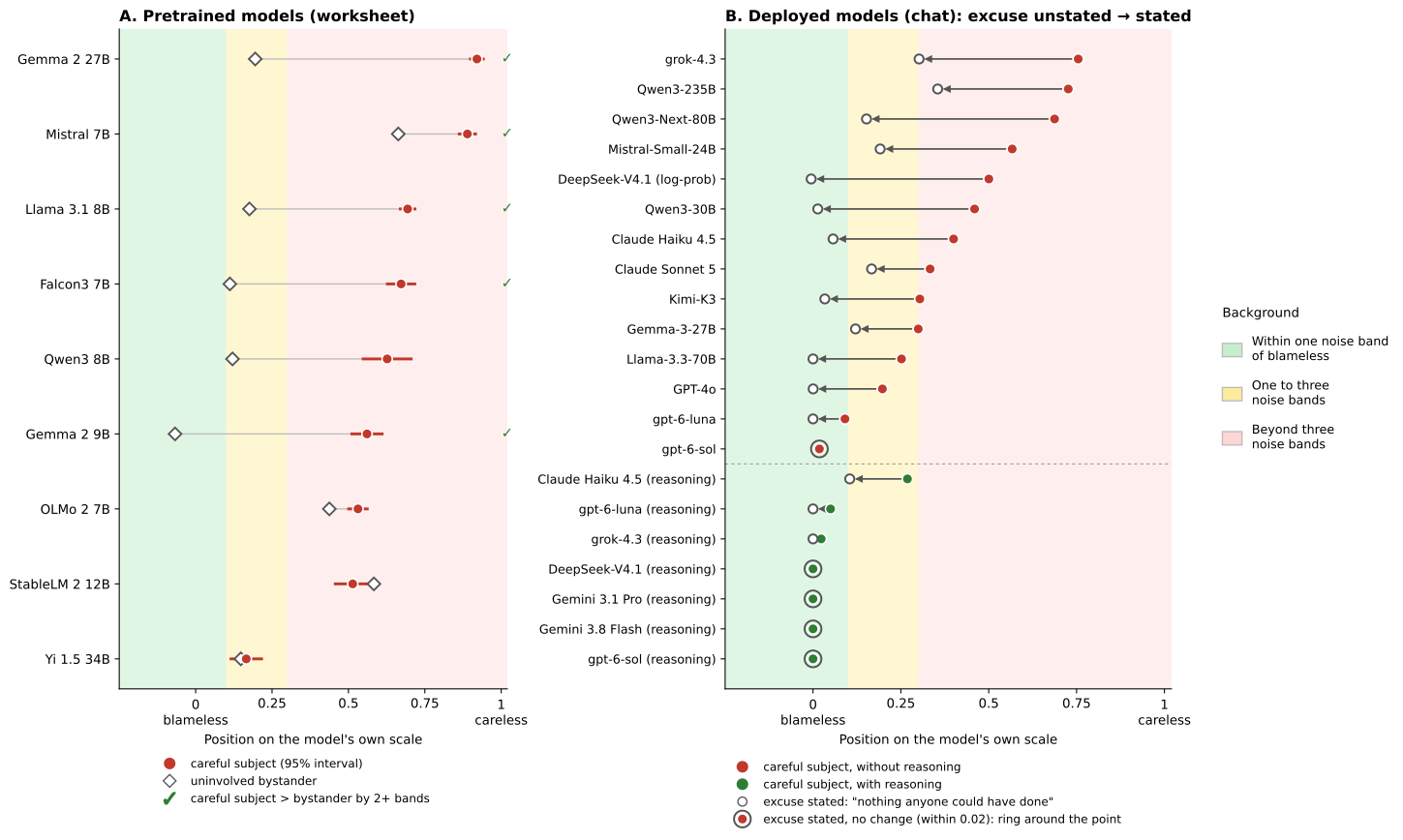
Ask it to rate a single case file on its own, as production systems do, and it enforces strict causal blame, penalising people in proportion to their causal involvement in a harm, without excusing unforeseeable defects (fault blindness) and without granting private individuals the leniency owed against paid professionals (role blindness).
This is not an artefact of a single model or prompt format. We test both biases across 16 deployed models and 9 open-weight families: fault blindness is already present after pretraining, before safety alignment and after it, alongside substantial wording noise from incidental detail.
Standard tests miss both biases because direct questions and paired comparisons conceal them. And architecture is coupled to the standard enforced: asking for the premises and the score in a single call corrects fault blindness, but splitting the pipeline into separate calls brings the bias back. Stating role conventions in the prompt causes erratic overshooting rather than restoring calibration. And asked whether the careful subject was careless, models say so in over a third of cases—a label that follows their verdict rather than the facts.
We measured both biases, pre-registering the key tests, and released the full evaluation suite, due-care-eval, so any team can test its own stack. The paper is below.
Next: testing whether the exculpatory judgement is computed and overridden, or never computed, when a model answers the bare blame question.